Showing posts with label Bugatti. Show all posts

Friday, February 4, 2011

Bugatti Veyron 16.4 Grand Sport

Bugatti Veyron 16.4 Grand SportFor 2009 Bugatti Veyron 16.4 Grand Sport launched. It is essentially a Veyron with a removable roof panel. There are also a number of models, special edition, including two Bugatti celebrate the anniversary of 100 years. The base price Veyron has also increased $ 200,000 to 1.7 million.

There are side and curtain airbags in 2009 Bugatti Veyron – an absolute minimum the authority of the government’s front airbags. The stability control, traction control and brake carbon-ceramic disc ABS are standard.

Bugatti Veyron 16.4 Grand Sport2009 Bugatti Veyron 16.4 Grand Sport is powered by a motor mounted centrally and quad-turbo W16 from 8.0 liters. Its 1,001 horsepower and 922 lb-ft of torque is delivered to all four wheels via a reinforced version of seven-speed Audi / VW ‘s high-speed sequential gearbox with double clutch (DSG). The automatic transmission has two modes – Normal and Sport – and could also be shifted manually with paddles on the steering wheel.

Bugatti Veyron 16.4 Grand Sport
As might be expected in a $ 1,700,000 car, cab Veyron is pretty fancy. The leather upholstery is plush and omnipresent, and large aluminum trim adorns the center console, steering wheel and other controls. gauge cluster has a little “power gauge” gadget that shows so-called power output in real time. The Veyron high waistline like a bathtub, annoyingly thick pillars and the low seating position does not improve his credentials as a driver of a car, but there is plenty of room in there, even for more people. To keep the elements out of the Grand Sport model, its removable roof panel has a central transparent glass which once in place may still bear Veyron speed. It is not the case with the accessory cloth roof, which can not be used until a recommended speed of 80 km / h. But at least it can be stored in the trunk before, collapsing like an umbrella with a removable pole that can be mounted indoors. Price of 2009 Bugatti Veyron 16.4 Grand Sport from $1,990,064

Bugatti Veyron 16.4 Grand Sport

Friday, December 31, 2010

Wednesday, August 18, 2010

Bugatti Veyron Sang Noir, 2008

Bugatti Veyron Sang Noir, 2008


The Bugatti Veyron Sang Noir is a special edition, created for the true automotive connoisseur. While its entirely black exterior may initially appear subdued, upon closer inspection it becomes clear that a select number of visual accents make this special Bugatti Veyron just as vividly coloured as its brighter counterparts.

Similar to its thoroughbred predecessor, the Type 57S Atlantic, the Bugatti Veyron Sang Noir exposes a raptor-like DNA that is reflected throughout the entire model history of the marque.

Even the hand-stitched, all-leather interior of the Bugatti Veyron Sang Noir plays on the theme of a 'harmony of extremes'. The light and confident Tangerine is offset by a black-piano lacquer finished centre console; both available exclusively to this edition. A dominant black tinted carbon fibre monocoque joins the elegant black body sides, which in turn are complemented by polished details.

The face of the Bugatti Veyron Sang Noir is instantly recognisable due to the iconic horseshoe grill, finished exclusively in chrome.
This striking and unparalleled harmony between luxury and sportiness is complemented by alloy-coloured details in the form of the chromed Bugatti grill and door-mirrors, as well as polished wheel surfaces and roof-rails. All-black front lights, air intakes, filler caps and door-handles naturally heighten the stunning effect of the racing-blue brake callipers.

Bugatti Veyron Pur Sang, 2007

Bugatti Veyron Pur Sang, 2007


The result is the EB 16.4. Veyron "Pur Sang", a two-tone study of pure materialness showing the car's true essentials: carbon and aluminium. The carbon monocoque holds the engine plus the passenger cell, while the polished aluminium panelling is enhanced by reflections in the sculpted bodywork.

Interestingly, the rawness of the materials even more strongly highlights the dual character of this car: performance power coupled with cruising comfort, structure and body, dark and light. A closer look at the details reveals the technical logic behind this stylistic appearance. The sophisticated monocoque contains all the core structural components, including the W16 engine, the passenger cell, the crash box and the linkages to the wheels. It is this purpose-driven fundament that is visible as the centre of the car in clear-coated carbon fibre.

Equally consistent is the use of the aluminium panelling. This lends shape and a unique body sculpture to the car, covering the wheels in a muscular and powerful expression by way of elaborately shaped fenders. Highly polished, these perfectly tensioned shapes strongly visualize the fascinating surface reflections that define every Veyron. The balanced graphic appearance is also visible when looking down onto the car from above. These qualities take on a distinct appearance - almost like that found in a Mondrian painting.

As its pur sang label suggests, this individualised customer car shares the same kind of DNA as that of classic cars from the Bugatti past: the "Atalante", the Type 55, the Type 41 "Royal" all had an unmistakeable and characteristic graphic signature. It is this precise division of performance components and body panelling - in this form - that makes the EB 16.4. Veyron "Pur Sang" unique in the supercar world.

BUGATTI VEYRON, 2005

BUGATTI VEYRON, 2005


The luxurious Bugatti Veyron length of 4.47 m, the Veyron is a perfectly balanced combination of high-powered performance and sleek, racy design.
The car’s enormous power is made visible by its impressive mid-engine, elevated majestically beneath the chassis.

Simultaneously, the Veyron’s bold proportions, well-balanced surfaces, and clear line structures give an impression of pure, sleek elegance.

The design of the Veyron honors a great heritage without drifting off into retro style.
Every detail of the classic two-tone color scheme, a quote from the 1920s and 1930s, has been carefully thought out, resulting in the typical Bugatti profile with the classic, contrasting ellipsis – the stylistic element used by Ettore Bugatti himself. The “crest line”, which runs uninterrupted from the hood to the only 1.21-m-high roof, is a proud homage to the Veyron’s forebears.
Thus, the Veyron’s classic paintwork and harmonious design connect this state-of-the-art super sports car to the glorious heritage of Bugatti automobiles.

With its classic look, the large radiator grill – adorned with the hand-enameled Bugatti emblem – represents the grandness of the Veyron.
The sports car’s distinctive front is defined by the harmonious contrast of its broad headlights and majestic grill.
The rear end, 1.99 m wide, features the formidable retractable spoiler and generously designed fenders.
The Veyron perfectly fulfills the main design objective governing the development of the new Bugatti: an uncompromising combination of highest elegance and state-of-the-art technology.

A bird’s eye view of the Veyron

Bugatti EB 164 Veyron, 2004

Bugatti EB 164 Veyron, 2004


Bugatti Veyron 16.4
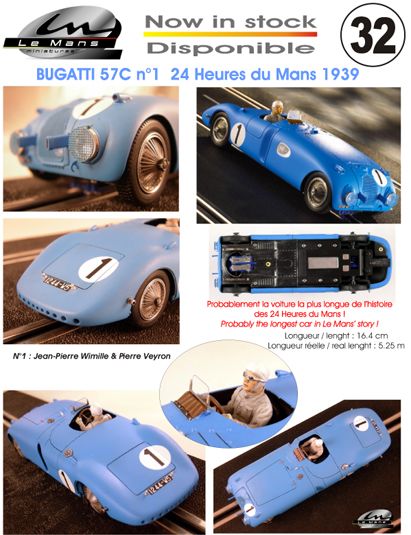
The Bugatti Veyron 16.4 is the most powerful, most expensive, and fastest street-legal production car in the world, with a proven top speed of over 400 km/h (407 km/h or 253 mph). It reached full production in September 2005. The car is built by Volkswagen AG subsidiary Bugatti Automobiles SAS and is sold under the legendary Bugatti marque. It is named after racing driver Pierre Veyron, who won the 24 hours of Le Mans in 1939 while racing for the original Bugatti firm.

History
Development of the vehicle began with the 1999 EB 18/3 "Veyron" concept car. Introduced at the Tokyo Motor Show, it was similar in design and appearance to the final Veyron production car. One major difference was the EB 18/3's use of a W18 engine with three banks of six cylinders. The Veyron was designed by Hartmut Warkuss of Volkswagen rather than Giorgetto Giugiaro of ItalDesign who had handled the three prior Bugatti concepts.

VW chairman Ferdinand Piëch announced the production Veyron at the 2001 Geneva Motor Show. It was promised to be the fastest, most powerful, and most expensive car in history. Instead of the W18, the production model would use a VR6/WR8-style W16 engine. First seen in the 1999 Bentley Hunaudières concept car, the W16 would get four turbochargers, producing a quoted 1001 horsepower (see engine section for details on the power output). Top speed was promised at 403 km/h (250.4 mph).
Development continued throughout 2001 and the EB 16/4 Veyron was promoted to "advanced concept" status. In late 2001, Bugatti announced that the car, officially called the Bugatti Veyron 16.4, would go into production in 2003. However, the car experienced significant problems during development. Achieving the required high-speed stability was difficult - one prototype was destroyed in a crash and another spun out during a public demonstration at the Monterey Historics event in Mazda Raceway at Laguna Seca. Production of the Veyron was delayed pending resolution of these and other issues.

Piëch retired that year as chairman of the Volkswagen Group and was replaced by Bernd Pischetsrieder.
The new chairman promptly sent the Veyron back to the drawing board for major revisions. Neumann was replaced as Bugatti president by Thomas Bscher in December of 2003, and substantial modifications were made to the Veyron under the guidance of former VW engineer, Bugatti Engineering head Wolfgang Schreiber.
In the case of the Veyron, it will be several years before Volkswagen will be able to see if their investment in developing ground-breaking technology has paid off. One key measure is how much (if any) of the technology developed for the Veyron finds use in mass-produced cars.
The first personally owned Veyron was debuted in front of Hotel De Paris in Monte Carlo during the 2005 Grand Prix.

Specifications
The Veyron features a W16 engine—16 cylinders in 4 banks of 4 cylinders, or the equivalent of two narrow-angle V8 engines mated in a vee configuration. Each cylinder has 4 valves, for a total of 64, but the narrow V8 configuration allows two camshafts to drive two banks of cylinders so only 4 camshafts are needed. The engine is fed by four turbochargers, and it displaces 8.0 L (7,993 cc/488 in³) with a square 86 by 86 mm bore and stroke.

The car's wheelbase is 2700 mm (106.3 in). Overall length is 4466 mm (175.8 in). It measures 1998 mm (78.7 in) wide and 1206 mm (47.5 in) tall.
Curb weight is estimated at 4,160 lb (1890 kg). This gives the car a power to weight ratio of 529 bhp/tonne.

Performance
According to Volkswagen, the final production Veyron engine produces between 1020 and 1040 metric hp (1006 to 1026 SAE net hp), so the car will be advertised as producing "1001 horsepower" in both the US and European markets. This makes it the most powerful production road-car engine in history. Torque is 1250 N·m (922 ft·lbf).

Top speed was initially promised to be 252 mph (406 km/h), but test versions were unstable at that speed, forcing a redesign of the aerodynamics. In May 2005, a prototype Veyron tested at a Volkswagen track near Wolfsburg, Germany, and recorded an electronically limited top speed of 400 km/h (249 mph). In October, 2005, Car and Driver magazine's editor Csaba Csere test drove the final production version of the Veyron for the November 2005 issue. This test, at Volkswagen's Ehra-Lessien test track, reached a top speed of 253 mph (407 km/h).

The Veyron is the quickest production car to reach 100 km/h (62 mph) with an estimated time of 2.5 seconds. It also reaches 200 and 300 km/h (124 and 186 mph) in 7.3 and 16.7 seconds respectively. It should also be noted that the Veyron's 0-200 mph (0-322 km/h)time is quicker than the McLaren F1's 120-200 mph (193-322 km/h) time. This makes the Veyron the quickest-accelerating production vehicle in history. It also consumes more fuel than any other production car, using 40.4 L/100 km (4.82 mpg) in city driving and 24.1 L/100 km (10 mpg) in combined cycle. At full-throttle, it uses more than 125 L/100 km (2.1 mpg)—at full throttle, the Veyron would empty its 100 L fuel tank in just 12.5 minutes. The car's everyday top speed is listed at 234 mph (377 km/h). When the car reaches 137 mph (220 km/h), hydraulics lower the car until it has a ground clearance of about 3 1/2 inches (8.9 cm). At the same time, the wing and spoiler deploy. This is the "handling" mode, in which the wing helps provide 770 pounds (3425 newtons) of downforce, holding the car to the road. The driver must, using the key, toggle the lock to the left of his seat in order to use the maximum speed of 253 miles per hour (407 km/h). Theoretically it can go faster but it is electronically limited to 253 miles per hour (407 km/h) to prevent tire damage. The key functions only when the vehicle is at a stop when a checklist then establishes whether the car—and its driver—are ready to enable 'top speed' mode. If all systems are go, the rear spoiler retracts, the front air diffusers close and the ground clearance, normally 4.9 inches (12.4 cm), drops to 2.6 inches (6.6 cm).

The Veyron uses unique cross-drilled and turbine vented carbon rotors for braking that draw in cooling air. Each caliper has eight titanium pistons. Bugatti claims maximum deceleration of 1.3 g on road tires. Prototypes have been subjected to repeated 1.0 g braking from 194 to 50 mph (312 to 80 km/h) without fade. With the car's fearsome acceleration from 50 to 194 mph (80 to 312 km/h), that test can be performed every 22 seconds. At speeds above 124 mph (200 km/h), the rear wing also acts as an airbrake, snapping to a 70-degree angle in 0.4 seconds once brakes are applied, providing up to 0.6 g (6 m/s²) of deceleration. Bugatti claims the Veyron will brake from 252 mph (406 km/h) to a standstill in less than 10 seconds. The braking is also so evenly applied that the car will not deviate from a straight path if the driver lets go of the steering wheel, even with the brakes fully applied starting from close to top speed.

Friday, August 13, 2010

Bugatti Veyron 16.4 Super Sport 2012

Bugatti fabricated big account aftermost ages back it apparent the Veyron 16.4 Super Sport. The 1200-horsepower supercar burst the assembly car acceleration almanac by extensive about 268 mph at the Volkswagen proving grounds, and it alike fabricated the fastest anytime lap about the Top Gear analysis clue in the easily of the Stig.


We've ahead alone apparent pictures of aloof one Super Sport archetypal – the record-setting car with the polarizing orange and atramentous acrylic arrangement – but now we apperceive that the Bugatti branch has spewed out at atomic two examples. The Super Sport fabricated its North American admission at the Quail Motorsports Gathering beforehand today with attractive dejected carbon cilia paint. We accept to say we abundant adopt it over its counterpart.


We've heard the record-setting Super Sport is additionally in boondocks and will be at Laguna Seca, so we'll hopefully be able to accompany you added photos of that car, and apprehend affluence added advantage from the Quail Motorsports Gathering throughout this weekend


2010 Bugatti Sports Cars Veyron from Mansory by Linea Vincero d’Oro

MANSORY understands the importance of combining luxury and technology with the golden aspirations of this unique sports cars. Adding to the list of many modified Bugattis sports cars, Mansory LINEA Vincerò d’Oro has created this incredibly gaudy-looking Veyron. It’s got some design changes, it’s got some gold and it’s one of a kind. However, Mansory will perform this modifications for anyone who has the cash to pay for it.
With the LINEA Vincerò d’Oro, MANSORY has completed its strictly limited series sports cars for the refined Bugatti Veyron 16.4 sports cars. Using targeted changes, MANSORY first transformed the Bugatti Veyron sports cars into the LINEA Vincerò and then, using a special gold-coloured alloy, into the unique LINEA Vincerò d’Oro.
This one-off super car tune job by Mansory is perfect for the individual with nearly inexhaustible wealth. The Mansory Linea Vincero d’Oro version of the Bugatti Veyron adds a carbon fiber aerodynamics kit and gold details on the grille, the tires, the door handles and gas tank. The interior is equally accented in gold color, but the rest of this beast is all Bugatti sports cars.
Along with such gaudy monstrosities as the Pepto-pink Bentley and the Polo Sport-on-acid Porsche Panamera, Mansory has modified the Veyron sports cars with the Linea Vincero range of accessories, including a full aero kit and highly polished carbon-fiber body panels that include copper threads interwoven into the material for even more flash.
MANSORY manufactures almost all the components in the car’s body from ultra-light, high-strength carbon and the autoclave method of hardening under high pressure and high temperatures used during the manufacturing process makes a huge improvement to the quality of the materials. One unique feature of the design of the LINEA Vincero d’Oro is the carbon fabric with inbuilt copper thread used by MANSORY, the metallic sheen of which really brings out the exceptional nature of this special sports cars.
2010 Bugatti Sports Cars Veyron from Mansory by Linea Vincero d’Oro
The sideskirts have also been remodelled, as to offer a more stunning look. To give the engine optimal cooling, Mansory has created larger air outlets to the side and rear of the Veyron. The diffuser has also had some work done, as to help with the handling of the sports cars.
Mansory and LINEA Vincero previously introduced a Bugatti sports cars with visual and performance upgrades that cost an extra $985,776 – on top of the sports cars.

Wednesday, August 4, 2010

Bugatti Look alike Based on the Mercedes HMC Hidalgo


Think of the Hidalgo as article like the European agnate of Japan's Mitsuoka Himiko Classic which is based off the MX-5. The Swiss replica is powered by the SLK AMG's 5.5-liter V8 agent bearing 355HP and 376 lb-ft of aiguille torque, acceptable abundant to get the Hidalgo from aught to 100km/h (62mph) in a claimed 3.4 abnormal and an electronically bound top acceleration of 250km/h (155mph).

Production of the Hidalgo is said to be bound to alone six assemblage a year, anniversary accustomed a amount of -hold on to your hats -€428,000, which is according to US$565,000 at today's barter rates.
A Bugatti Lookalike Based on the Mercedes Benz SLK AMG

A Bugatti Lookalike Based on the Mercedes Benz SLK AMG


Monday, July 26, 2010

Bugatti Sports Cars Type 12-2 Concept Car

Bugatti Sports Cars Type 12-2 Concept Car
Here is a Bugatti Concept CarBugatti Type 12-2. Racer X has lifted the covers on a new concept vehicle they are calling the Bugatti Type 12-2 concept car which is highlighted by ample storage space and new practical designs. Bugatti is a most famous sports car manufacture, so it is just about power, speed, luxury and everything, designed especially for those who love speed, comfort and style.

Bugatti Type 12-2 concept has been created as a 2+2 sports GT for the Bugatti brand. it is not intended for production. Designed as an example of a luxurious four seater GT, the type 12-2 is the artwork of Reuben Zammit.

The idea is to use a VW derived W12 engine with a twin turbo layout hence the name 12-2. Although not as extravagant as the W16 used in the Veyron, there would be enough power to propel the Type 12-2 to over 200 mph. Every time it competed with 4 different demo cars in 2 different classes for bodystyling.

On the subject of performance, things get considerably more hypothetical. This being purely a design study (and not even a Bugatti-commissioned one) any power-train speculation should be taken with more than a few grains of salt. Racer X's specified FR configuration seems to eliminate the Veyron's all-wheel drive, quad-turbo W-16 configuration. Meanwhile, the name "12-2" seems to hint at a 12-cylinder mill sleeping beneath the coupe's hood.


Bugatti Sports Cars Type 12-2 Concept Car
Pop over to Racer X Design for more images of the Type 12-2 Streamliner concept. While you're there, check out the rest of its portfolio, which features a few wild takes on Chrysler, BMW, and Alfa Romeo vehicles.

Monday, July 19, 2010

Bugatti Sports Car Concept Type 57 Evoluzione

The Designer Edwin Conan brings us another retro inspired supercar: the Bugatti Type 57 Evoluzione concept. The Bugatti Type 57 Evoluzione concept is a plenty of futuristic sports cars. This is called by the Type 57 Evolve Concept and impressed by its design, which is based on historical models of the firm, as the Type 35 and obviously the Type 57 Atlantic.
Bugatti Sports Car Concept Type 57 Evoluzione
The Bugatti Type 57 Evoluzione concept is amazing supercar inspired from the original Bugatti Type 57, dating back from 1930s. The idea is that this legendary designer resurgence with a motor model W16 derived from Veyron , with the difference that this run on hydrogen.
This concept car, like the original Type 57, has a stretched bonnet, smooth curves and a split line which bisects the car down the middle. This Bugatti supercar design is the revival of the classic Type 57, with a touch of modern technology.
On the side we see an excellent comparison with his predecessors, on the same lines we note Type 57 Atlantic with the fall of the tail, the separation line that divides the car perfectly in the middle and the door design. In the images we appreciate a highly successful retro design. In the rest Edwin bring the legendary achievement of the new millennium model, incorporating a new front wheel arches, more affiliates optical and fluid, and new dimensions.
It is far from being a sports car and very close to being known as a luxurious and exclusive vehicle that has a long stretched out bonnet just like in the 1930’s. This design cue was one of the trademark styling elements of the Type 57 Atlantic.

Friday, July 9, 2010

2010 Renaissance Bugatti Sports Cars Concept

2010 Bugatti Sports Cars Concept Renaissance
The 2010 Bugatti Renaissance is a concept car created by Canadian designer John Mark Vicente. He is a graduate of the Communication Design program at the Emily Carr University, has come up with some ideas of his own. Look like it’s same with Bugatti Veyron Supercar, but it’s his proposal for next supercar from Bugatti. Come with Veyron, 16-cylinder, but it’s still concept car.
Along with the obvious genes from the current Veyron, the Bugatti Renaissance Design Concept throws in some touches of the Audi R8 and some serious styling.
The Renaissance is a model based on the Bugatti Veyron, the vehicle that replaces it. Although running on the same platform as the Veyron, the exterior design of this concept Bugatti is far more aggressive, and overall…better.
At the front of the car, the grill has grown in size and the headlights have been redesigned, now resembling the ones on the Audi R8 and also it has a carbon fiber skirt that fits great. Above the cockpit we notice that the twin roof vents are now slightly larger.
At the back, there are two larger vents, redesigned tail lights and the Bugatti logo framed by a red line that goes all the way to the roof scoops. The car uses impressive 26 inch rims.
Released as the fastest and costliest car when it hit the market, the impressive Veyron was an absolute stunner. Equipped with an 8.0 litre W16 engine delivering an incredible 1001 horses, Veyron had a top speed of 408.5 kmph (253.8 mph). It catapulted from standstill to 100kmph in just 2.5 seconds and cost above 1.55 million U.S. dollars.
Related Posts Plugin for WordPress, Blogger...